Condition of the covering
The first check is for splits, blisters, shrinkage, punctures or worn edges in the felt or membrane.
Flat roof repairs in East Ham often centre on the small roof sections added to terraced homes over time, such as rear kitchen extensions, bay tops, porches, dormers and side returns where water can sit and old coverings can split at the edges.
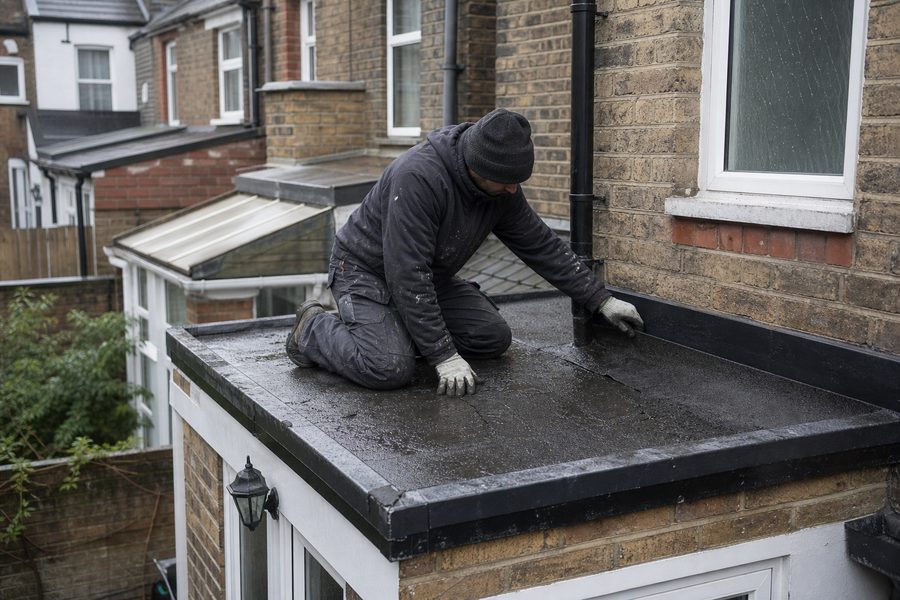
The problem on a flat roof is not always the point where water shows indoors. Roofers usually look at the whole run of the covering and the junctions around it.
The first check is for splits, blisters, shrinkage, punctures or worn edges in the felt or membrane.
If water is sitting after rain, the roofer needs to see if the roof has lost its fall or if outlets and gutters are holding water back.
Many leaks start where the flat roof meets brickwork, upstands, drip edges or parapet details rather than in the middle of the roof field.
Flat roof repair is a regular need in East Ham because so many homes have gained extra roof sections over the years. A classic terraced house may have a pitched front roof, then a small flat section over the rear addition, a bay top at the front, perhaps a dormer to the loft and another covered section above a porch or lean-to. Those smaller roofs age at different speeds and are often patched one at a time.
On a compact East London terrace, the rear addition roof is especially important. It sits below the main rear slope, collects water from above and often meets neighbouring walls, party lines or gutter details. If felt has cracked or a wall chase has opened, rain can enter quietly for weeks before the homeowner sees staining in the kitchen ceiling.
Many East Ham flat roofs have already been repaired more than once. One section may have a newer patch while the surrounding covering is much older. That can work for a time, but it also creates hard edges and mixed movement across the roof. When rainwater sits on those joins, another split often appears nearby.
A bay roof is another common weak point. It is small, easy to forget and exposed from above. Once water gets through the covering, the damage often shows around the front window reveal or ceiling corner rather than in a way that clearly points to the bay itself.
Flat roofs on East Ham properties are not always easy to inspect from ground level. Rear extensions sit behind the main house, side returns can be screened by neighbouring walls, and dormer tops are well above sight lines from the garden. That means a leak may be active long before the failed section is visible to the owner.
Because these roofs are small, people sometimes assume the repair will be simple. In practice the difficulty often lies in the detail work around the edges. A split at a corner, a lifted drip trim, a failed lead chase or a blocked outlet can cause as much trouble as a larger tear in the centre.
Sometimes a local patch is enough, especially if the covering is otherwise sound and the damage is limited to one identifiable area. In other cases the roofer may advise that a small flat roof has reached the point where repeated patching no longer makes sense. That judgement usually depends on age, how many layers of repair are already present and how much moisture has been trapped below.
On East Ham terraces with parapet edges or raised party walls, the repair can also involve checking how water exits the roof and if debris has been stopping it from draining properly. The roof surface and the rainwater path need to work together.
Say if the leak affects a rear extension, bay roof, dormer, porch or side return, and mention if water sits on the roof after rain or if the problem follows long wet spells.
Get a QuoteThe right repair depends on the age of the roof, the amount of standing water, the quality of the edge details and how much previous patching is already in place.
A roofer may patch a split, renew a failed corner, re-dress a wall upstand, replace edge trims, clear a blocked outlet or advise renewing the covering on a small section that has become unreliable. The key is to match the remedy to the actual source of water entry instead of covering the whole roof in sealant and hoping for the best.
Rear addition roofs on East Ham terraces often need careful attention where the flat section meets brickwork from the main house or a neighbour's wall. If the old chase has loosened, or if water has been standing against the upstand, the repair needs to secure that line properly.
If the roof feels soft underfoot, if decking below has taken water, or if the same leak has returned after several small patches, it is worth saying so at the quote stage. That helps roofers judge if a patch is still realistic.
Bay roofs can also need timber edge work if water has been creeping in at the front lip for some time. The covering itself may only be part of the repair.
On dormer roofs, access and safe working arrangements can affect the price as much as the size of the failed area. Mentioning the dormer at the start usually leads to more realistic quotes.
Flat roofs over side returns and narrow passages may have awkward drainage arrangements. A repair that ignores that drainage path can leave the same trouble waiting to come back.
If the fault follows heavy rain but not light showers, tell the roofer that as well. It can point towards ponding water, overloaded outlets or a weak edge detail that only fails under heavier flow.
Where a flat roof joins older slates or tiles above, the repair may also need to check flashings and tile edges so water is not spilling down onto the new patch.
The aim is to stop water getting into the house and to leave the roof in a condition that will hold up through another wet East London winter, not just through the next weekend.
Flat roof faults often overlap with leaking roof work, felt repairs and conservatory or extension junction leaks.
Yes. Water can sit in the roof build-up or travel into adjacent plaster and timber for a long time before the problem looks serious indoors.
No. Some need only a local repair, but repeated patching on a tired roof often stops being good value.
That pattern often points to standing water, a weak edge detail or drainage that cannot cope once the roof stays wet for longer.
If your East Ham flat roof is leaking or holding water, you can compare free quotes from local roofers covering rear additions, bays, dormers and porches.
Get a Quote