Sheets, laps and fixings
Roofers look for lifted laps, loose screws, corrosion around fixings and distortion where the covering has moved.
Metal roof repair in East Ham is usually about smaller domestic roof sections such as lean-tos, canopies, garage roofs, bay tops with metal flashings, and older sheeted coverings that have started leaking at laps, fixings or wall junctions.
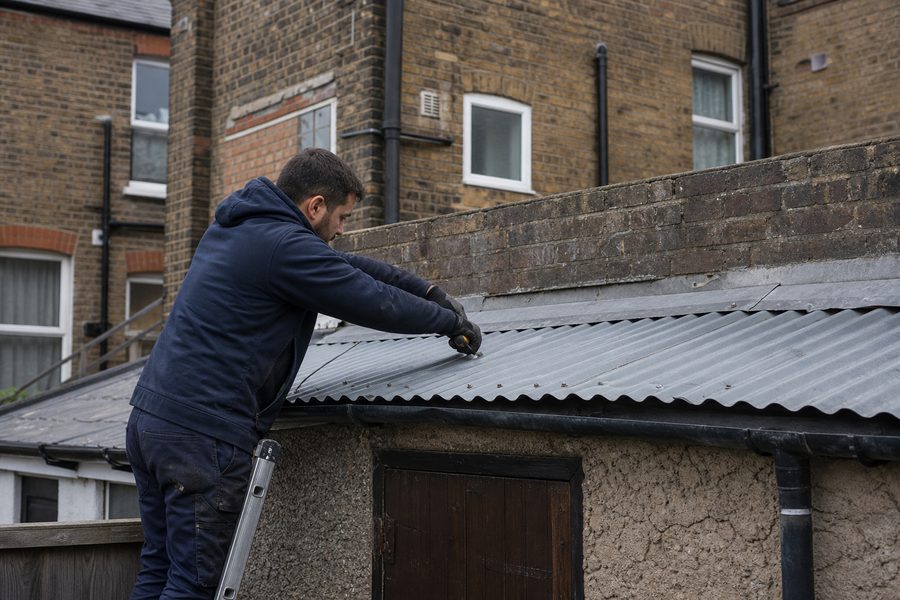
With metal roofs and metal roof details, the key questions are where water is getting through and how movement or corrosion has affected the joints.
Roofers look for lifted laps, loose screws, corrosion around fixings and distortion where the covering has moved.
Many leaks start where a metal roof meets brickwork, trim edges or a neighbouring roof section.
If a sheet roof has been leaking for a while, the timber below can soften and affect how well any repair will hold.
Metal roof repair is a narrower category than tile or felt work on East Ham homes, but it still comes up in useful ways. Some garages and lean-tos have corrugated sheet roofs. Some porches, canopies and bay details rely on metal flashings. Older domestic outbuildings may also have lightweight sheeted coverings that have started leaking at laps, fixings or wall abutments.
In a terraced area where space is tight, these small roofs often sit close to walls and boundaries. That makes edge details important. Water commonly gets in not through the middle of the metal but where the covering meets the house wall, a side return, a timber trim or a patched edge.
Corrugated and sheeted roofs can leak when fixings loosen, washers fail, sheets corrode around the screw points or overlaps stop lying tight. Once wind begins to work on a lifted edge, the opening usually grows. The first visible sign inside may be a drip line along the garage wall, rust staining or damp patches on stored items.
Another issue is thermal movement. Metal expands and contracts more obviously than tile or slate, so poor fixing details and ageing seals can work loose over time. That matters on East Ham garages and lean-tos that get strong sun on clear days and cool down sharply at night.
Some people only think of leadwork as part of larger heritage roofing, but in East Ham it is often relevant on everyday terraced homes. Flashing around chimneys, walls and parapets can crack, lift or pull away from mortar chases. A leak blamed on tiles can sometimes turn out to be a problem in the metal detail beside them.
Bay roofs and little canopy sections can also depend on metal edge protection or flashing details that are no longer doing their job. Once those joints open, water can run back under the covering and into the timber below.
Domestic metal roofs are often offered quick paint-on fixes. Sometimes a coating has a place, but if the trouble is a loose overlap, corroded fixing hole or failed wall junction, paint alone rarely solves the real problem. A better repair starts with the source of the leak and the movement that caused it.
That can mean refixing sheets, replacing failed fasteners, renewing a short section of flashing, securing a lifted lap or dealing with the timber support beneath the leak if it has already deteriorated. The exact answer depends on the condition of the roof as a whole.
Describe the roof type, the use of the structure, where the leak shows and if the issue seems to involve overlaps, fixings, rust, flashings or a wall junction.
Get a QuoteDomestic metal roof repairs are usually local and detail driven, but they still need the failed section to be addressed properly.
A roofer may replace corroded fixings, reseal or refix laps, patch a local split, renew a flashing line, replace a short sheeted section or repair the timber below if long term leaking has weakened the support.
If the roof in question is a garage or lean-to, say if the inside gets condensation as well as direct leaks. That can help separate a water entry problem from a ventilation issue, or show that both are happening together.
On East Ham properties with narrow boundaries, the repair may need to be planned around tight side access or close neighbouring walls. Mentioning that can make the first quote more realistic.
Where lead or metal flashing is involved, it is useful to say if the leak appears beside a chimney, parapet or wall junction rather than in the middle of the roof area.
Some old sheet roofs have already had bitumen or sealant spread over them. That can hide the true path of the leak and may need careful removal before the repair can be judged properly.
If a garage roof is noisy in wind, if a sheet visibly lifts, or if rust marks are showing around fixings, mention those signs. They point towards movement rather than only a pinhole leak.
A metal roof repair can also include edge trims and rainwater details if water is escaping where it should be draining cleanly.
Small domestic metal roofs are easy to neglect because the leak seems isolated. On a storage space or side access roof, though, repeated wetting can still damage timber, plaster or boundary walls over time.
The best value usually comes from repairing the actual failure line and its support, not from spreading another layer of mastic across the whole roof.
Metal roof faults can overlap with flashing leaks, garage roof work and general leaking roof investigations.
Yes. Water often gets in around loose screws, failed washers and lifted laps long before the sheet itself has completely worn through.
No. Some need only local refixing or flashing work, though badly corroded areas may need a section replacing.
Because sheeted garages and lean-tos can suffer from both, and the repair plan may need to account for each issue separately.
If your East Ham garage, lean-to or metal roof detail is leaking, you can compare free quotes from local roofers for metal roof repairs.
Get a Quote